
Soil Testing
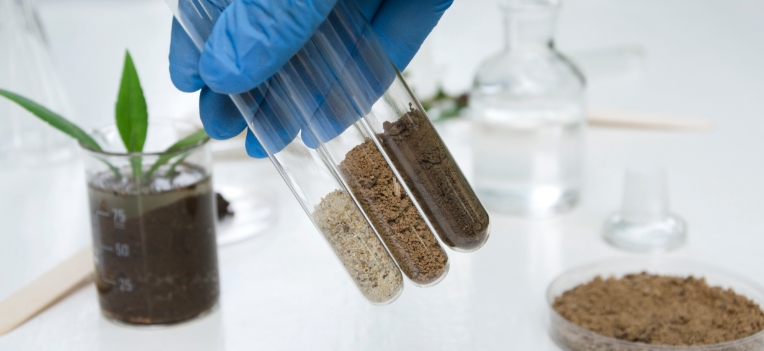
Cultivator Phyto Lab excels at providing complete soil testing services for agricultural and non-agricultural lands. As the properties of soil vary depending on its composition and type the quality of the soil is judged by analyzing those properties that limit the usage of land. We test soil samples across the season and types and provide special services. There are various chemical testing parameters offered namely, pH value, porosity, water content, organic carbon, potassium, etc.
Test Methods: As per all national and international methods like AOAC, APHA, EU, Indian standard, FSSAI, ISO, own validated methods and customer supplied methods. Indian Standards (IS) (USFDA) (ASTM) (AOCS) (ASTA) (PAM) US-EPA Methods (API) (IP)(FCC), In-house validated methods.
Soil Testing Parameters
| pH value | Porosity | Arsenic |
| Organic Carbon and Matter | Relative Density | Boron |
| Nitrate Nitrogen | Texture | Cadmium |
| Ammoniacal Nitrogen | Sodium | Chromium |
| Grain Size Analysis | Specific Gravity | Cobalt |
| Wet Sieve Analysis | Electrical conductivity | Copper |
| Exchangeable Calcium | Cation exchange capacity | Lead |
| Exchangeable Sodium | Field Capacity | Magnesium |
| Exchangeable Potassium | Water holding capacity | Manganese |
| Water content | Soil moisture | Mercury |
| Total Soluble Solids Calcium Carbonate | Available Phosphorous Available Sulphur | Molybdenum |
| Total Kjeldahl Nitrogen | Chloride | Nickel |
| Aluminum | Phosphorus | Silver |
| Tin | Potassium | Zinc |
NEWS AND BLOGS
Find up to date information, news releases, and corporate publications for Cultivator Phyto Lab customers

Food Adulterants: The Silent Killer Hiding in the Plain Sight
Food is at the epicenter of life. The times may have changed but the importance of food has remained. What scares us is that when food is impure or contaminated, it may be life-threatening as well. This puts the consumer in a constant dilemma of what to eat and what...

How to test water?
At least one color disk test kit is available for fluoride. However, portable digital colorimeters are often preferred because of concerns over accuracy. Ackvo Caddisfly, a testing system, recently described a colorimetric fluoride test that can be read by a smartphone app. Portable field testing options for arsenic are limited; this contaminant is best…

Factors to consider while choosing the Lab
Choosing an analytical testing laboratory or the type of test methods to confirm or identify the condition of a food or beverage product is not an easy task. Decisions need to be made on the types of testing that are appropriate or necessary